
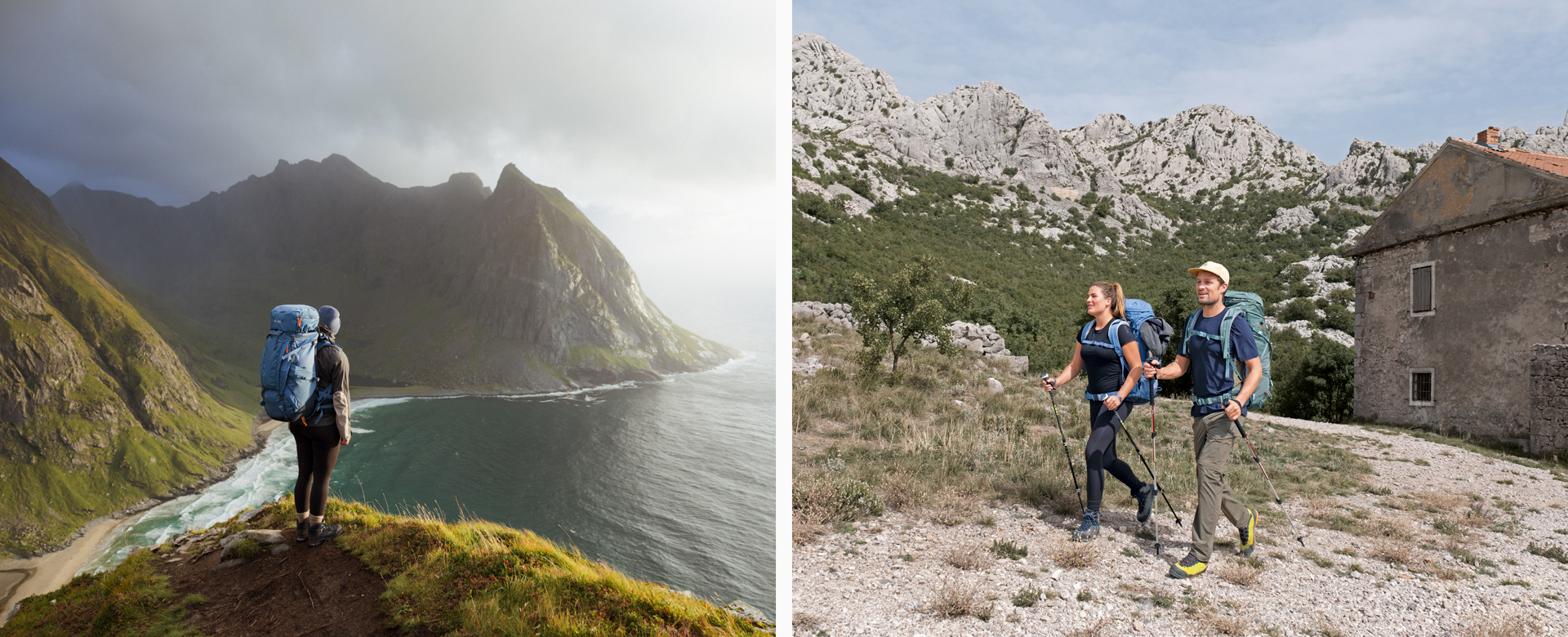
Both trekking and touring backpacks are designed for multi-day hikes. They differ in size and in the design of their carrying systems, as they are intended for carrying more or less gear. As a general rule: the more gear you need to carry, the larger your backpack needs to be, and the more stable and robust the carrying system should be. A daypack, on the other hand, is intended for day trips. It has a volume of between approximately 15 and 30 liters and a lightweight, flexible, and well-ventilated carrying system.
| Backpack category | Backpack volume | Pack weight | Activity |
| Hiking backpack | 35 liters | up to 10 kg | Day hikes with a lot of gear (e.g., family hikes); hut-to-hut hikes with light packs |
| Touring rucksack | 40 – 45 liters | up to 15 kg | Hut-to-hut hike; also suitable for shorter trips |
| Trekking rucksack | 50 – 60 liters | V2 carrying system: up to 25 kg X1 carrying system: >25 kg |
Multi-day hike including tent, sleeping pad, sleeping bag, stove, and food; also suitable for backpacking |
| Trekking rucksack | 70 – 90 liters | V2 carrying system: up to 25 kg X1 carrying system: >25 kg |
Winter trekking, expeditions with heavy luggage |
When it comes to packing weight, the rule is always: Pack only what you really need in your backpack to keep the weight as low as possible.
Less gear means a lighter pack; more gear means a heavier pack. This results in differences in the design of the carrying system.
The carrying system of a trekking rucksacks is designed to carry heavy loads over long distances as comfortably as possible on your back. That’s why it’s heavily padded.
The hip belt—the central element of the carrying system – is also relatively stiff, so that some of the weight can be efficiently transferred to the pelvic area, relieving pressure on your shoulders and back. However, the stiffer the hip belt is, the less mobility you have in the hip area, which also limits your overall mobility – which is a bummer, for example, if you have to do a bit of scrambling on hikes. (That’s why it makes a lot of sense to use trekking poles on trekking tours—they help you maintain your balance.)
To ensure that a trekking rucksack’s hip belt functions optimally, it should be positioned centrally on the iliac crest. That’s why you can adjust the carrying system of a Tatonka trekking backpack to fit your back length.
The carrying system of a touring rucksack follows the same principle as that of a trekking backpack. It transfers part of the load to the hip area, thereby relieving pressure on the shoulders and back. However, since you don’t need to carry as much gear – and, especially on hut-to-hut hikes in the mountains, you want to be more agile – the carrying system is lighter overall and the hip belt is designed to be more flexible. This allows you to control the backpack better and, for example, tackle climbing sections on mountain trails more easily.
In another post, we’ll explain how to adjust the carrying system of a Tatonka touring backpack to fit your back length.