Water column for tents – this is how high it needs to be
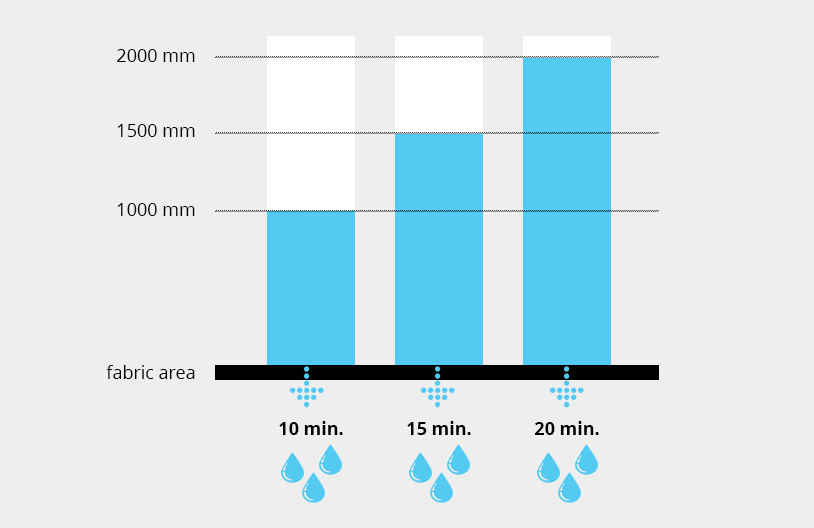
A tent fabric must be waterproof—that goes without saying. To describe this waterproofing, it has become standard practice to use the so-called water column as a benchmark. Measured in millimeters, it indicates the water pressure a fabric can withstand before it allows moisture to pass through. You can find out how this measurement is performed below.
According to DIN standards, outer tents are considered waterproof at 1500 mm or higher, and tent floors at 2000 mm or higher.
Water column rating for Tatonka tents – it all comes down to the material and the coating
Tatonka uses various materials with different water column ratings in its tents.
For tent floors, Tatonka uses a tightly woven nylon fabric with a durable, abrasion-resistant PU coating. Because the pressure on a tent floor is concentrated in specific areas (kneeling, sitting, lying down), the material has a water column rating of 10,000 mm.
For its heavy-duty lightweight tents in the Expert and Expert-Light lines, Tatonka uses a very lightweight, highly tear-resistant nylon fabric with woven-in stronger threads—known as ripstop fabric—as the outer tent material. This fabric is coated multiple times on both the outside and inside with a silicone elastomer. This type of coating creates a very high and durable water-repellent effect. In practice, even in extreme storms, the outer tent does not experience water pressure of 1,500 mm water column or more. Water takes the path of least resistance; it spreads across the fabric and runs off, but does not penetrate the coated fabric—the excellent water-repellent effect further supports this. The lightweight material is therefore permanently waterproof, highly durable, and very UV-stable despite the comparatively low water column of 1,500 or 3,000 mm.
For the outer tents in its Allround line, Tatonka uses PU (polyurethane)-coated polyester fabric. Polyurethane coatings age faster than silicone elastomer coatings. A high initial water column rating ensures that this material remains waterproof for a longer period of time. It has a water column rating of 5,000 mm, is durable and tear-resistant, and offers good UV stability.
Water column for Tatonka tents – varies by tent model
Tent series
Outer tent fabric
Water column
Tent floor fabric
Water column
Allround
68 den Polyester 210T PU
5000 mm
70 den Nylon Taffeta 190T PU
10 000 mm
Expert
20 den Nylon 6.6 Ripstop 250T SI
1500 mm
70 den Nylon Taffeta 190T PU
10 000 mm
Expert LT
20 den Nylon 6 Ripstop SI
3000 mm
70 den Nylon Taffeta 190T PU
10 000 mm
Water column – how is it measured?
The water column of technical fabrics is measured in the laboratory using a test known as the hydrostatic water pressure test. The test determines how much water pressure a defined, stretched fabric surface can withstand over a defined period of time without allowing water to pass through. The result is expressed as the height of an (imaginary) water column that produces this pressure on the fabric surface.
Seams and zippers on Tatonka tents—waterproof thanks to adhesive bonding and coverings
In addition to high-quality tent fabric, careful craftsmanship is also essential to ensure that the tent is as waterproof as possible.
Taped seams
A tent is sewn together from individual fabric panels; only then can it take on a specific shape. By their very nature, the seams consist of tiny holes connected by threads, which can naturally allow water to pass through. To prevent this, all seams are sealed (also known as “taped”).
This taping works very well on the flat panels of the tent. It may not work as well in the corners, where multiple fabric panels meet. That is why the tent floors of Tatonka tents are designed so that there are no seams in the corners. There, the fabric is folded and layered over each other. While this means the fabric isn’t completely smooth in the corner, it is definitely waterproof. The tent floor is also designed in the shape of a floor tub—meaning it is raised about 20 cm on the sides. This ensures that no water can penetrate, even during downpours or heavy rainfall.
Covered zippers
The entrances to the outer tent are closed with zippers. To prevent water from entering the tent through the zippers, they are fitted with covers that are secured with Velcro tabs. These covers prevent water from entering.
How sturdy are Tatonka tents in a storm?
Tatonka tunnel tents are extremely wind-resistant when pitched with the narrow side facing the prevailing wind direction.
Thanks to the use of high-quality materials and meticulous craftsmanship, Tatonka’s Allround, Expert, and Expert-Light tents are waterproof and can withstand even heavy rain. The tunnel tent design, when pitched with the narrow side facing the wind, is highly wind-resistant.
Tip: If you expect bad weather while camping, it’s important to secure the tent carefully with all the stakes and use all the anchor points for the guy ropes so that the tent remains as stable as possible even under stress. In addition, a suitable groundsheet—while not strictly necessary—protects your tent from moisture from below and from damage (e.g., from sharp rocks).