Tips for setting up your tent – how to do it right
You should set up your new Tatonka tent at least once at home when you have plenty of time. That way, you’ll be familiar with all the parts and know exactly what to do, so setting up the tent on vacation will be a breeze. During your trip, be sure to always choose a suitable campsite to avoid unpleasant surprises. Always use a groundsheet. Whenever possible, secure your tent at all guy points so it can withstand adverse weather conditions.
How to set up your Tatonka tunnel tent
Spread out the groundsheet: Lay out a groundsheet that fits the tent to protect the tent floor.
Assembling the tent poles: Slide the tent poles together. The individual sections are connected by a rubber cord running through the tubes. Make sure the sections slide together smoothly and don’t get stuck.
Setting up the tent: Unfold the tent on the groundsheet. To help you orient yourself, look for the vents located on the narrow sides of the tent. The inner tent is already attached to the outer tent and is set up together with it.
Setting up the tent: Position the tent with the narrow side facing the prevailing wind direction. If the tent has a flatter end, choose that side to drive in the first stake.
Secure the first short side of the tent: Secure the central loop of the short side of the tent facing the wind with a tent stake. This makes the rest of the setup easier, especially in strong winds.
Assigning tent poles: If the tent poles are different lengths, make sure to assign them to the correct tent channel.
Insert the tent poles into the pole channels: Insert the tent poles one by one into the pole channels. These channels have an opening on only one side. Push the poles in until they slide into the designated slots on the other side.
Tension and secure the tent poles: Once all the tent poles are in place, tension them one by one and secure each end in the designated holder (e.g., a pole cup). The tent poles now form arches that will determine the tent’s final shape.
Unfold the tent and fill it with air: Unfold the tent from the narrow side that isn’t yet secured to the ground. Lift it with both hands to fill it with air.
Secure the second short side of the tent: Press the tent down onto the ground and secure it at the end with two tent pegs in the loops provided.
Position the groundsheet: Now position the groundsheet so that it doesn’t extend beyond the edge of the tent. This prevents water from getting under the tent floor when it rains.
Drive in the remaining stakes: Secure the tent at the remaining anchor points with stakes.
Align and secure the guy lines: Tension the tent further with the guy lines and secure them with stakes.
Choosing the right campsite – Do’s and Don’ts
Don’t pitch your tent in a low-lying area—it could flood if it rains.
Pitch your tent in the shade whenever possible to reduce UV-induced wear and tear on the tent fabric.
Choose a campsite with a “breeze”—in a completely sheltered spot, your tent won’t be adequately ventilated. In hot weather, heat will build up inside the tent, and more condensation will form.
Don’t pitch your tent under a large, isolated tree to avoid the risk of a lightning strike.
If you camp under trees, tree sap can stain the outer tent. This does not impair the tent’s function, but it cannot be removed without damaging the outer fabric.
Before setting up your tent, remove sharp objects, rocks, etc., and use a groundsheet to protect the tent floor.
Position your tent with the narrow side facing the prevailing wind direction. This ensures the best possible ventilation and, in extreme cases, allows you to fully utilize the tent’s structural stability.
Tension your tent at all guy points; this increases its stability.
Tensioning options and variants for your tent
If you carefully set up your Tatonka tunnel tent and secure it at all designated tensioning points, it will be extremely wind-resistant.
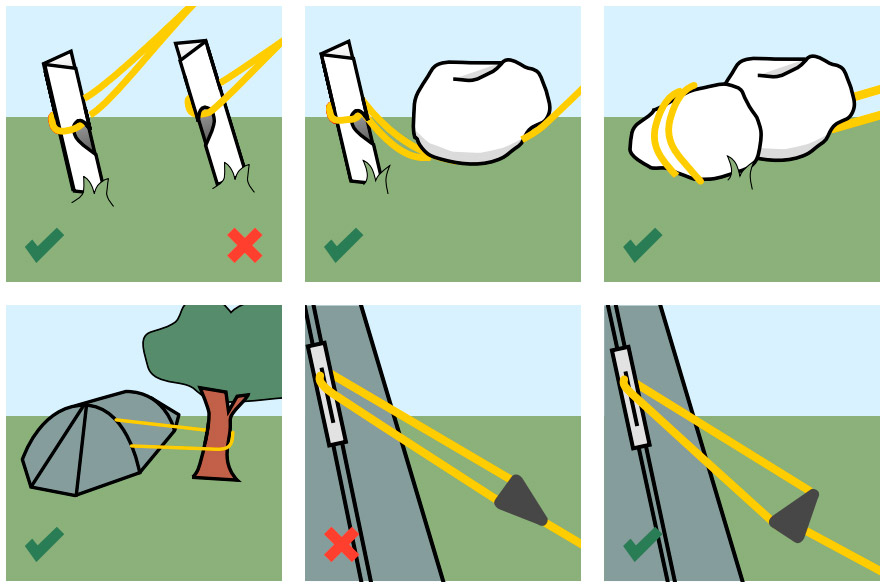
Make sure to always drive the tent pegs into the ground at an angle, with the pointed side facing away from the tent.
On very hard ground, you can use stones or similar objects to reduce the tensile load on the tent peg.
If you are unable to drive a tent peg into the ground, you can secure the tent with two stones.
Also use the natural surroundings for securing the tent (e.g., trees, fences).
You can also use pieces of your gear (in winter: skis, ski poles, snowshoes; in summer: hiking poles, boat, bicycle) for tensioning if the tent stakes cannot find a secure hold.
Make sure that the tensioners on the guy line are always under tension and properly angled so that they do not slip.
Pitching and taking down in the rain
If you need to take down your Tatonka tent in the rain while on a trip, you can first remove the inner tent—which is still dry—and pack it separately. Only then should you take down the wet outer tent.
The next time you set up the tent, put up the outer tent first and then hang the dry inner tent inside.