
If you’re out camping, you probably already know this: a tent isn’t a hotel room. It protects you from rain and wind, but only with one or two layers of (waterproof) fabric. That means you experience every kind of weather—heat, cold, rain, and wind—pretty much firsthand. However, there are tips and tricks for different climates and weather conditions to make your stay in the tent as comfortable as possible.
In strong sunlight and warm temperatures, heat builds up inside a closed tent. So the rule is: Open all tent entrances! Tatonka tunnel tents have entrances to the outer tent at both ends for this purpose.
Here’s what you should do
Tip: Tatonka offers two tunnel tents designed for hot climates: the Grönland 2 Vent LT and the Grönland 3 Vent. With these tents, you can roll up the side walls of the outer tent, leaving you to sleep essentially in just a mosquito net.
Lying in your tent during a steady rain and listening to the raindrops drumming on the tent can be nice sometimes. Packing up and setting up a tent in the rain, of course, is less so. Tatonka tunnel tents have the advantage in the rain that you can first set up the outer tent and then hang the dry inner tent inside.
Here’s what you should do
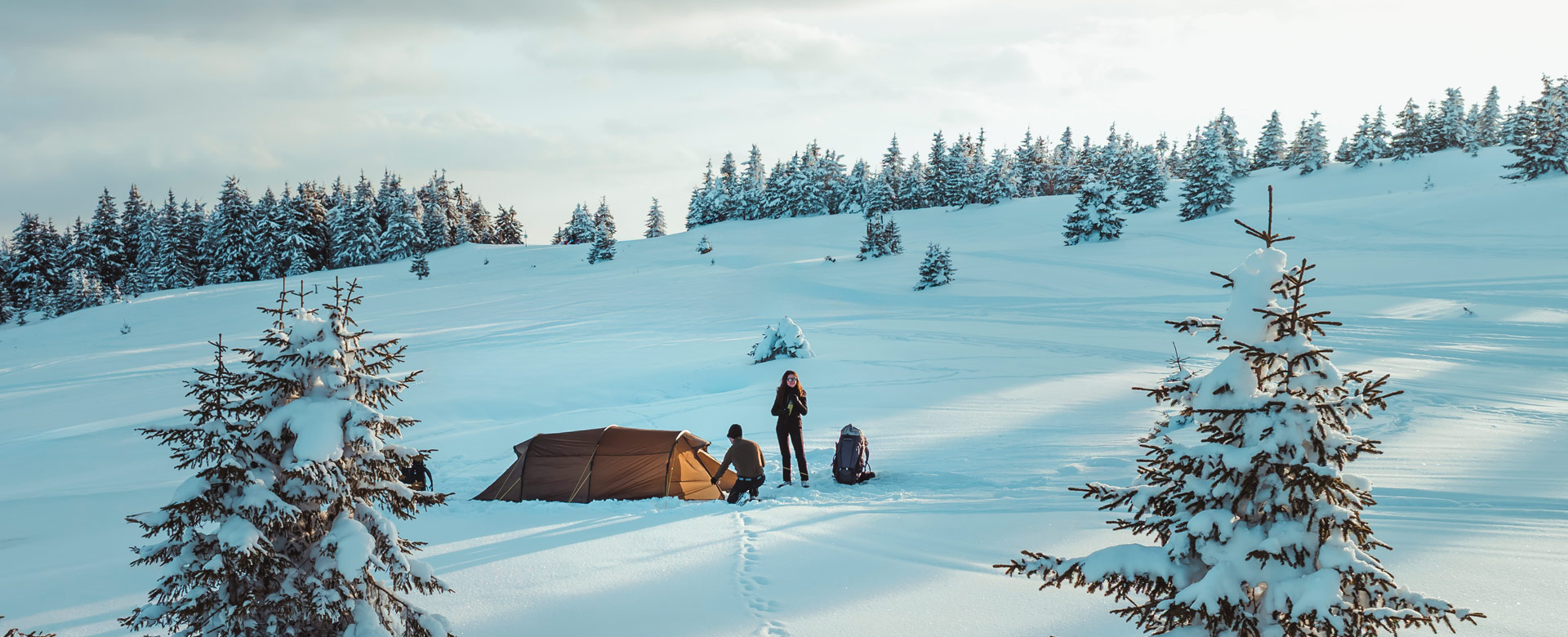
You can camp in cold temperatures, even when it’s below freezing, without any problems. Of course, it will be cold inside the tent as well. That’s why you need cold-weather gear: a cold-weather sleeping pad and a cold-weather sleeping bag. Both items specify the temperature range for which they are designed. These values should be understood as guidelines. You must take your own sensitivity to the cold into account.
What you should do
Tip: Stuff the clothes you’ll wear the next day into the foot of the sleeping bag. That way, they won’t be completely cold in the morning.
New campers in particular often wake up after their first night in a tent and are surprised to find moisture on the inside of the outer tent, even if it hasn’t rained at all. This is condensation; the tent isn’t leaking. Depending on the campsite, weather conditions, and ground surface, as well as the size of the inner tent and the number of people sleeping inside, every tent will develop some degree of condensation. However, you can often reduce condensation with simple measures.
Here’s what you should do
Tip: You can easily wipe condensation off the inside of the outer tent with a soft cloth.